

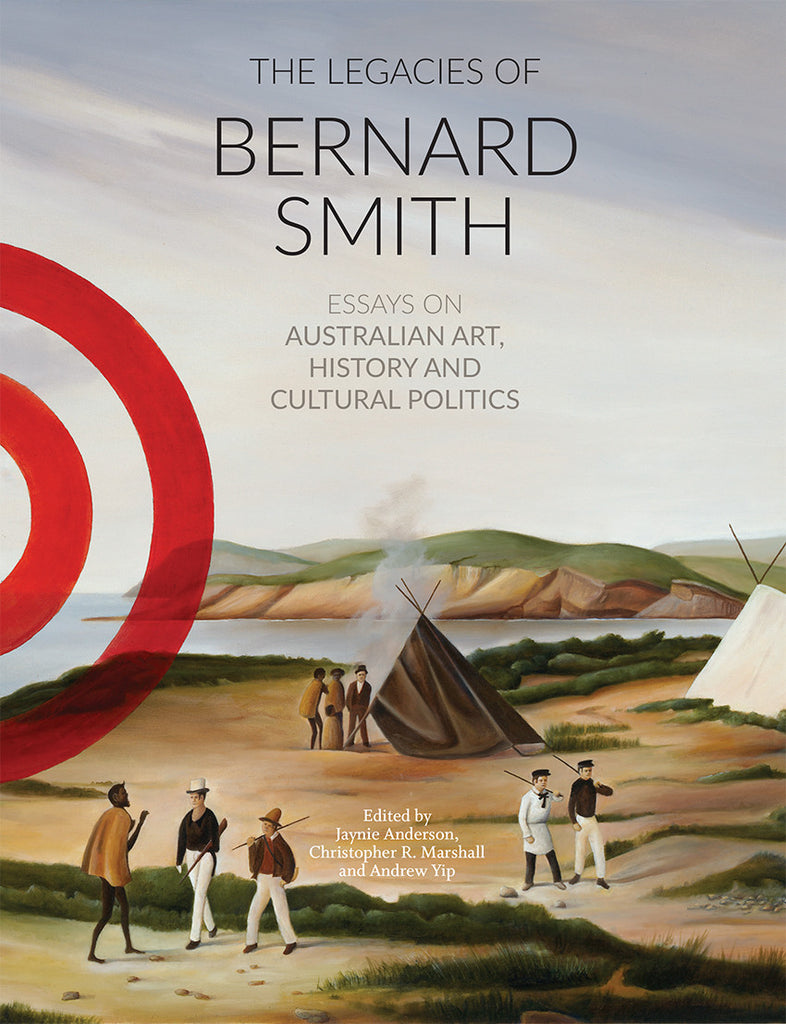
The Legacies of Bernard Smith (eBook)
$9.99
Edited by Jaynie Anderson, Christopher R. Marshall and Andrew Yip
Winner of the 2017 AAANZ Best Anthology Prize
An international field of scholars from art history, anthropology, history and literature, as well as curators and writers, explore the impact and legacy of Australia’s most revered art historian.
It has been widely asserted that Bernard Smith established the discipline of art history in Australia. He was the founding professor of contemporary art and the directory of the Power Institute at the University of Sydney, published the classic art text Australian Painting, three volumes on the art of Captain Cook’s voyages, and two memoirs. This publication brings together international academics from a range of disciplines to focus on everything Smith left his mark on, from Antipodean and European ‘envisioning’ of the Pacific; the definition of Australian art, gallery scholarship and public art education; museological practice and art criticism to Australian art biography and local heritage.
Contributors
Jaynie Anderson; Andrew Sayers; Robert W. Gaston; Nicholas Thomas; Rüdiger Joppien; Kathleen Davidson; Terry Smith; Peter Beilharz; Catherine Speck; Paul Giles; Simon Pierse; John Clark; Steven Miller; Joanna Mendelssohn; Christopher R. Marshall; Jim Berryman; Ann Stephen; Max Solling; Kate Challis; Sheridan Palmer; Catherine De Lorenzo; Ian McLean.
In The Legacies of Bernard Smith, you will also find chapters reflecting on his time as a grassroots activist in the Sydney suburb of Glebe, as a collector who believed in a common responsibility to support the arts by purchasing new work, and as a public intellectual facing up to the consequences of colonial violence. The collection [is] eclectic, but could it be otherwise?
—Andrew Fuhrmann, reviewed in Australian Book Review
The great value of the volume is its wide appeal, breaking down the barriers between academe and Smith’s cultural activism on so many fronts. The essays are arranged as follows: 1) European Vision and the South Pacific, regarded as his major contribution; 2) Defining Australian Art; 3) the Art Museum, and 4) Cultural Politics. The arrangement reveals both surprising common purpose and fascinating ambivalence of allegiance in his work as a biographer, autobiographer, literary stylist, cross-cultural methodologist, curator, travelling art educator, buyer, personal collector, local heritage activist, and his tactical liaison with a host of institutions inside and outside Australia.
Certain essays by friends, colleagues and relatives are worth particular mention for their warmth of personal affection and objective psychological insight. Others for their ability to supplement Bernard’s intellectual achievement with recent advances in the disciplines. Foremost among these is Nicholas Thomas’s deceptively simple, generous and convincing demonstration of how Smith’s most powerful insight into the reciprocal influence of European and indigenous knowledges enables new museological appreciation of the active plasticity of Pacific responses to European occupation through the evolution of indigenous networks of cooperation in politics, commerce and religious culture that can be understood as a kind of alternative modernism, freed of the preconception of timeless and unchanging traditionalism. Our other highlights were chapters by Robert Gaston, Rüdigger Joppien, Terry Smith, Jim Berryman, Kate Challis, Catherine de Lorenzo and Ian McLean. All the essays together suggest the rich debates that this book’s diversity of approach is likely to inspire across the spectrum of interest in the past and future art of this region. As Jaynie Anderson explains in her introduction, the cover image on the book by the Noongar artist Chris Pease superimposes an abstract Jasper Johns target upon a nineteenth-century landscape painting of European landfall (Target, 2005). It vividly articulates the moral intensity of the conflicting political and aesthetic claims that Smith’s work continues to make on many of us. Our congratulations to the winning anthologists and the authors and editors of other commended works.
–Richard Read, Lisa Beavan, Cathy Speck, Judges for 2017 AAANZ Best Anthology Prize
ISBN 978-0994306432
eBook
24-page colour images


